I love winter and four-season climates for the simple factor of change; dynamic interactions. The rhythm changes and evolves as the days shorten and lengthen through the seasons. Oddly enough, winter is a time of year when the day length lengthens, so while it feels like a time to go inward and rest, which it is, it’s also a time to ramp up towards the burst of life known as spring. Winter Orchard Garden doings will get a step ahead and create more space in spring for intentional action.
Please read the checklist below and click here to see if any of our upcoming courses serve you in your growing and homesteading journey.
 Winter gives you time to slow down and be with your orchard garden, food forest, or any other growing style. There is only so much you can do on a given day although as we will see below there is still plenty to do. However, it may not be like a typical summer day of cranking on production, now there is a bit more space for reflection and observation. Like a loved one, spend some high-quality time with your growing space being grateful for what was, honoring what is, and seeking clarity on what it will become next.
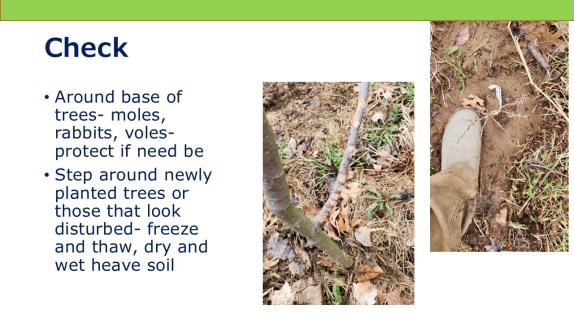
One of the largest determinations of whether trees or bushes make it in year 1 is how often you check on them for herbivore damaging (browse) and lifting from moles and frost heave. As winter transitions to spring or even those great maple syrup runs of days above freezing then below freezing at night, the soil contracts and expands, also with varying levels of humidity. It’s our job to step around the base of the plants to ensure ground to root contact. This is so incredibly vital. And if you are seeing gnaw marks from rabbits or voles, figure out a strategy to mitigate that like short cages for rabbits.

This is the time of year that we get our ducks in a row to ensure the next phase of implementation is successful. So you run through the design process and figure out the above question of both the plant world, fertility needs, and the built environment. A design only gets you so far, you have to do the project management to really get plants in the ground and nutrient dense food growing. At this time of year, I am planning how to dial in my own orchard garden and the ones I build for clients as their systems evolve and wish list continues to expand.

Ahhhhh, the art and science of pruning, a true favorite winter activity. This is where you get to know each tree in a more intimate way and help in its upcoming journey of the growing season and life in general. One of the art meets science parts is seeing the tree as it is, bare and naked, but also envisioning in a few months when it is full of leaves and has grown six or so inches on every branch, what will it look like then, what spaces will it occupy? And remember don’t do too much in a year, step back and change positions often, and enjoy the process.
 Snow helps to push organic matter to the ground and here in my location in Northern Kentucky in 2025, we have had the help. Most winters as of late have not been so helpful, so instead, it’s you the steward that needs to get out and still do chop and drop. It cycles carbon resources back to soil microbes and covers bare soil. Building soil is a year-round process and I tend to use my Rogue hoe at this time of year to get to those hard to whack back blackberries.
 As winter gets closer to spring and new beds are being prepped or summer beds are being readied, cover cropping can grow a lot of biomass starting in late winter or early spring. I use a mix of Austrian Field Pea and Barley at this time of year, which i buy in as animal feed from Azure Standard. Grow it and cut it back a couple weeks before you want to plant into it. Never let it flower and cycle it back to the earth to build soil quickly.
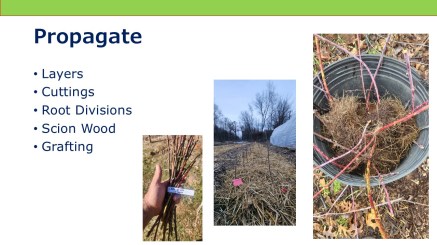 Our field Nursery in the Orchard Garden here at Treasure Lake will be abuzz with taking cuttings, lifting layers, and gathering scion wood in early February. Grafting and root divisions take place closer to the cusp of spring. This is a great way to get return on investment in your orchard garden through creating plant stock. First you grow the mother plants for a couple of years then begin to utilize these different horticultural techniques to create more plants. Sell them or expand!

Just because its winter doesn’t mean you can’t forage or harvest in the orchard garden or the broader acre non timber forest products. I will begin tapping my sugar maple trees this winter in late January and the season should last six weeks. Before the snow hit this year, I came across winter oysters on my back hedgerows as well as carpets of chickweed, a common herb where mulching has occurred and fertility is built. At that same time I harvested some horseradish from one of my 50 ft production rows. And I always harvest Jerusalem Artichoke throughout the winter, but the sooner the better especially as the days warm up.

Our growing spaces sometimes need expanded and sometimes just dialed in. Either or, getting rid of sod for establishment or dealing with the weeds that are inherent in agriculture, we do bed prep to define the space and let the plants we want get settled in appropriately. So I often use a combination of these techniques in establishment. Fire can be used in late winter when things are dry to burn back perennial weeds and grasses to cycle that carbon material into a potassium rich ash. Fire is not a yearly thing but a valid tool nonetheless. Same for tilling, its a great way to break a sod layer for establishment but not something I recommend doing consistently. I do like sheet mulching and if you know where you want to plant, sheet mulch months in advance to reduce tillage. I have come to the conclusion that compaction is one of the largest problems in agriculture. So, I use the subsoiler implement behind a 2- or 4-wheel tractor as well as the hand tool known as a broadfork. Lastly, I do sometimes use silage tarps for solarization, although their effectiveness is better outside of winter when the sun is higher in the sky.

Of course once you do the bed prep or get the materials together as in sheet mulching, you can plant. If the ground isn’t frozen, you can plant. I maybe wouldn’t plant if I see a crazy cold stretch ahead but a plant in the ground vs in the pot, hmm, it may actually be better in the ground. Now I do try and plant as early in possible in general in the year as I am trying to beat the heat and dry periods. So I do as much prep as I can early on, to get plants in the ground as soon as they arrive or I find the time amongst the nine million late winter tasks I have for myself on the farm and in the install business.
Below are a couple of example of research I also do during winter to get ready. Peruse nursery catalogues to research the disease resistant cultivars you need. A topic for a coming blog!


A foundation in maintaining your growing spaces organically is mulching. I prefer to layer green material layers that consist of hay/ manure (bedding) with woodchips. That helps balance the Carbon to nitrogen ration and really unlock fertility while also providing weed protection and moisture retention. One of the keys to mulching for weed prevention is thickness and this is partly how I justify the usage of hay. It has to be thick, not a thin layer like you would with straw. Regardless the addition of organic matter in layers helps tremendously with so many things and really is a primary activity during winter. Beat the weeds! And while doing it observe, and check and you are bound to make some other observation that will help you make a critical management decision.
 At the end of the day, we do all these activities to gain a yield. And its not just about the food we harvest, but the beauty, the vibe we inspire. It’s about the habitat we create, the carbon rich soil we build, and the growth that makes you wonder how this is even possible. And we leverage our horticulture skills with plant stock to make nursery stock for whatever downstream we see fit. The yields are only possible if we get out and do and simply be.
 TreeYo Permaculture
Leave a comment