
Sadhana Forest 5 week PDC-Tamil Nadu, Auroville, India, January 2009
Kaila’s research in ecovillages had brought her to the 70 acres reforestation project of Sadhana Forest in 2008. Because of resonance with the visoinaries of the project Aviram and Yorit and the project itself, Kaila decided to teach a PDC there in 2009. While at a teachers training course in late 2008 at the Esalen Institute in Big Sur, Ca,USA, Doug and Kaila met and decided to travel to India together to teach this newly learned style. Viewed as training opportunity in teaching a PDC, Kaila and Doug left in mid January from the states. Gautier appeared just days later saying to them one evening ” I heard there’s some people here with an idea of teaching a Permaculture Course”. And the trio was born.
While wanting to keep the class size small, many volunteers at the project showed a keen interest in taking the course. So just before the course started 30 people had signed up and we had to cap it at that or it would have been more. The course itself was unique in that there was very little money transfered other than money that the students donated for Kaila and Doug’s registration through Tagari as certified teachers and the cost of the certificates that certification enables you to hand out.

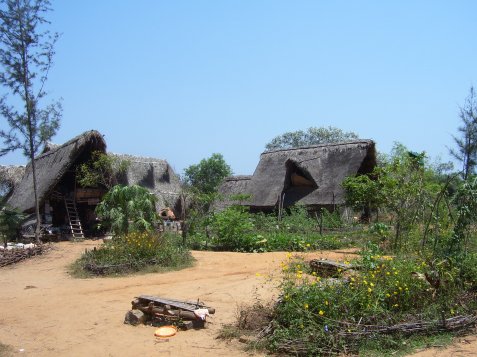
This meant a rigorous five weeks to accomplsih essentailly a two week course. Volunteers worked for four hours each morning and had other roles within the community as well. In the afternoons class was held in one of the causarina frame, keet thatch roof huts. Additionally some evenings had movie screenings and power point presentations for the whole community. Twice a week we would have hands on during the morning to help reinforce the topics we were discussing. It was a very intense course with the schedule, the heat of India , and the constant flux of people that is Sadhana Forest. At one time the volunteer numbers were up to 120 and finding space was a challenge but just another design opportunity.
The 30 volunteers who signed up came from 13 different countries and five different continents. This was accompanied with the fact that over half the group was comprised of English as a second language. This presented some challenges for the newly formed teaching team but they were viewed as learning opportuities. Construction of many garden beds, overhauling the greywater system, and plastering the rammed earth bag house known as the eco-dome were all hands on projects that the group focused on. This really helped to transform Sadhana forever as embarks on its goals of more self sufficiency. Sadhana is a remarkable story of how through water harvesting, water conservation, and tree planting you can turn a desert into a forest that grows people. The water table had been raised six meters and 20,000 trees had been planted.

The course empowered many of the students to take on lead roles during the morning worktimes to accomplish longer term permaculture projects. An example of this is the picture above as Fatima and Hila were extremely dedicated to seeing the plastering of the eco-dome be accomplsihed. Others went wild with mulching and creating garden beds and focused on food production in this harsh climate.

 TreeYo Permaculture