Video Above of acorn foraging and goats, Courses – Treeyo Permaculture to learn more, and blog below
When you read the tall tales of J. Russel Smith’s foundational work, Tree Crops: A Permanent Agriculture (1929), you ponder in awe these times of slower life, less energy access, and robust systems. These systems consist of plants, animals, and human communities working together for long term yields that are in hope cyclical and regenerative. You read about the fattening of hogs with grandiose trees and farmers saving money on feed bills and ponder how I can do that too. After observing this phenomenon for a few seasons now here at our 60-acre generational farmland, I can unequivocally say goats love acorns and honey locust pods. I can remember a few years back; a young and beautiful and sprite goat continually jumping out of my side garden pasture and being so confused on why it was so. The newly rotated pasture was full of all sorts of greenery for the fading photosynthetic time of year, mainly grasses and nonnative vegetation during autumn. And yes, the grass is always greener on the other side of the fence and in this case an old growth Shumard Oak (Quercus shumardii). I would find her sniffing in the leaves, low angle sun in a dappled shine, russet brown and red leaves hanging firmly in the tree, and an undetected scent in the air from my inferior nose. Fermenting or recently hit to the ground acorns must smell divine as the drive to get out of the pasture is akin but maybe not quite as strong as when the cycles of heat come in for these mammals. I have seen bucks pull off Hermes like feats to get out of pastures to mate. As well, I have been tormented by the deep guttural yearnings of does for literal days screaming for insemination. This fall I have witnessed, experienced, and felt sprints of whole herds as they approach oak trees knocking my knees as they crunch past me in these autumn times. And they aren’t looking up and seeing the leaf structure or examining habitat or bark types as humans do while identifying a tree. They use another form of intelligence, another instinct, smell and the desire to fatten with the cooler temperatures and shorter days. And if you closed your eyes and had a herd of 20 goats around you under a producing oak after a windy day or cold snap, you would almost think there were pigs around. Snorts, grunts, leaf wrestling, and the unmistakable crunch. Acorns are unique in that they have so much meat and yet such a thin shell. So while I see them eating acorns, I don’t see them
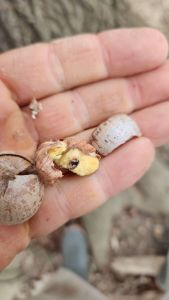
crunching the thicker shelled hickory or walnuts as a pig would. You can tell the goats are utilizing scent and also their whiskery antennae to find them and see if they are good. As I shepherd them in these falls days to the trees, I practice a permaculture principle, observe and interact, which is a form of the scientific method. With that curiosity begins to peak as you quietly observe the herd, why do they spit some out or go by others? So I started to pick some quality appearing acorns up and hand feed some of the more friendly ones, including those bucks that can’t seem to rub their stink on you enough. What I noticed in my experiment was, that they used their nose, whiskers, and mouths to interact with the acorns. The ones they reject I open and indeed nearly every time there is a bug hole underneath with a tell-tale black spot of rot. So, while my eye can’t see through the shell, their senses can. It’s one of the most interesting things an imagination can do in my opinion, is to begin to try and “see” the world the way another creature does. The discerning nature of a ruminant is so clearly evident in this matching of eyes and nose and whiskers and mouth.


Furthermore, in a recent walk to the oaks and still green nonnatives, I thought let’s go check on another delightful cinema of delicacy feasting. The productivity of this one very mature, nearly spinless honey locust growing at the base of hill that ends at the banks of the lake facing south is remarkable to say the least. With its 60 ft height and 50 ft crown, this stately tree is so evident from afar because of the spiral marron black pods in absolutely staggering numbers. And underneath after a fall swing in temps, the goats happily sprinted to them once the smell started wafting as well. I knew to shepherd them there as I have been watching this crop for months waiting for this day as I have observed the goats loving the mix of sugar and protein and fiber mixed in these near foot long pods years before. When I crack one open, I can smell tamarind from the tropics and carob from the mediterranean, reminders of my globetrotting days and their fodder legume family cousins. These days I shepherd and observe the way the goats systematically keep the pods in their mouth and eat it a few inches at a time. I watch as some eat 5 or 10 or 20 at a time while others eat a few and move back to grasses and rose bushes. I wonder what is their taste pallet telling them? I wonder if they know their manures might help produce the honey locusts spawn since scarification through animal ingestions is a key to the spread of honey locust. In the end, everything gardens.
Watching pregnant does and growing bucks gain nutrition from these mighty givers is humbling and reminds you of indeed, those tall tales from the Tree Crops book. It makes me want to look up those old numbers on nutrition content, ask others about their goats turning into piglike creature experiences, and how curious it is on how goats nonchalantly make their way through the foot long sandwich of beans and tangy goo of locust pods. It reminds me to steward our forests organically, which goats do so well with, so that the manures can enrich the soil rather than chemicals killing larvae on land and in nearby waterways. It’s a good reminder of these connections and makes you think how with shepherds doing the work of traversing with herds, acorns and pods can be eaten. Bayer doesn’t care about your forests but when pulsatively rotated and shepherded through, goats do. GOAT!

 TreeYo Permaculture
Leave a reply to Tree Crops Connections: Goats, acorns, and honey locust pods – Permaculture Design Course Handbook Cancel reply